Seiko 7A38 - by the numbers
Subtitle
Forums
| Forum Home > Parts Info, Tech Tips and Tinkering > Crystals and gaskets | ||
|---|---|---|
 Member Posts: 284 |
I've been catching up with this thread - but I'm running before I've learned to walk and daily I become more aware of just how much I don't know. Mechanical things have always been obvious to me, but searching databases, is difficult to say the least. I've robbed one from the 7289 I'm working on but will then have to source a replacement and have so far failed to do so. Oddly, there it a tiny mesurable difference between those two watches. Bewildering how Seiko have so many variables. . Pressing in. I seem to be getting worse not better at this. Do you think it's better to lead from the opposite edge to the opener gap and feed it across, or keep it deal level at all stages? (I've used the former until now, and it's worked well, but the last one with the oversized? ring was a mess and has somewhat unnerved me. ) | |
| ||
 Site Owner Posts: 14428 |
It depends on the case / bezel you're trying to press back together, Rob. Some seem to work better with the nylon gasket fitted to the bezel, others with the gasket laid in the recess in the top of the case. One thing is CERTAIN. If you pinch, stretch or distort it by the smallest amount - forget it. It's 'Game Over' for that particular gasket. | |
| ||
 Member Posts: 568 |
I use a VERY thin film of clear silcone grease on the nylon ring then wipe it off --Seems to make the thing slip in better. Also when I remove the ring I mark the top with a black marker so that it does't get flipped over upon installation. | |
| ||
 Member Posts: 284 |
Yes, I always put mine in a box out side up. Tonight, with having nicked one from a watch-in-waiting, I was not sure. I eyeballed the tramlines and tried hard to figure out the way it went in. Both watches were the same, but in, it wouldn't go. There is a lip on used gaskets that goes into the body under the first surface. I reasoned it was imperative to get that lip under that rim. Silicone is tempting, isn't it? I didn't give way to that, but I was thinking of all sorts of escape routes by then. Indeed, I spent ages, at times thinking there was no way this was going to work, and it was strange becaues until the damaged one, I had got them started and just applied a good percentage of my 200 lbs. This time it was very hard to start, and even harder to press. It's gone down, but I like things to go together smoothly - I find it bodes well for jobs lasting. When I'd done this, I then struggled like never before to get the bars in - but that's gettin away from crystals and gaskets. I'll pop some pics on that are taken in daylight. | |
| ||
 Member Posts: 284 |
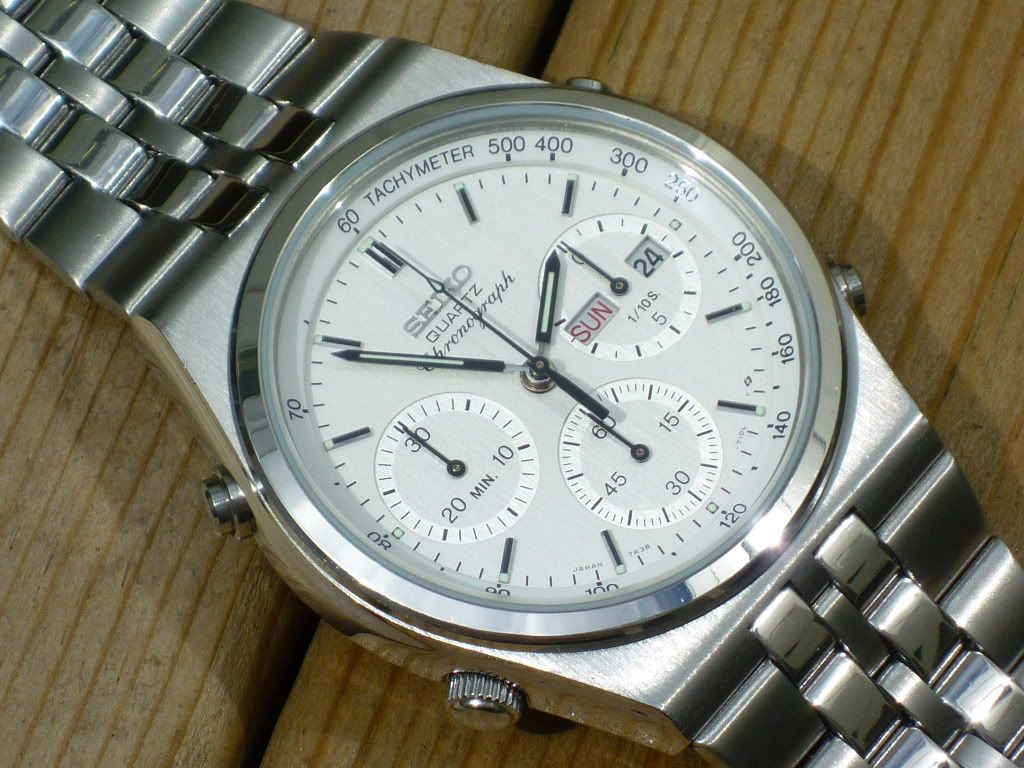
I've had a miserable Sunday. Ages spent trying to refit a bezel onto a 7A38-7289 using a new Seiko 8617 8990 part. I squished the first one and then found it to be too long. The plastic is very, erm, plastic. The second one seemed no better, and at $11 a go the project was going into the red. I finally managed to get it in, but the time taken was bizarre. I need a supply of reasonably priced gaskets and the secret technique Seiko use to get them started. Heating the case is frought with problems when the Tachy scale is so vulnerable - even given that one drops it in after the warming process. . Can anyone confirm that the section of the (white) gasket is symetrical? Looking at the damaged one, I felt that one edge was slightly thinner than the other, but I couldn't measure the difference. | |
| ||
 Site Owner Posts: 14428 |
Rob. Like the glass to bezel gasket, the white nylon bezel to case gasket is symmetrical when new - there is no top or bottom edge. However, just as with the glass to bezel gasket, once it has been fitted (by Seiko, in the factory) the bezel to case gasket will have been partially compressed - but not for its complete depth. Ergo as Don stated, you need to make 100% certain it goes back in the same way up it came out. I have had some limited success experimenting with both Cousins own brand / ISO Swiss white nylon I section glass gaskets in place of the original Seiko bezel to case gaskets. (Generally they were too loose a fit, compared to the originals). http://www.cousinsuk.com/catalog/watch-parts/glass-gaskets Though I can't remember the part numbers that almost worked (or the dimensions needed) for the moment. | |
| ||
 Member Posts: 284 |
I experimented with a two-pot mix of plastic glue last night. On a very battered case, I might add. I put two test strips c 6mm long - one on either side - and left it for 12 hours or so. It's a very rubbery glue, and my fear was that it would be impossible to undo, but it seemed okay-ish. I'm going to try several products, but keeping the mix off the tachy ring will be a challenge to say the least. | |
| ||
 Moderator Posts: 40 |
Originally posted as a new topic: Bezel Gasket by Donwatch on March 23, 2014 at 3:46 PM What to do about missing or damaged bezel gasket ? | |
| ||
 Site Owner Posts: 14428 |
Suggest you read the foregoing posts, Don. PS - Depends which particular 7Axx model case to bezel gasket you're referring to of course, but one of the most commonly used on 7A38's is Seiko p/n 86178990, which is fortunately still available. Otherwise start experimenting with I section nylon glass gaskets. | |
| ||
 Member Posts: 284 |
Over here, the problem was the cost. $11 a go, and no guarantee the darn thing would slip in. It's the plasticity of the thing, crush it and it's a mile too long . . . for ever. . I even polished off the leading edge of the bezel, and at one stage paired off the square edge of the nylon. It worked, but what a bizarre procedure to fit a simple part. I wonder how Seiko do it......... . My drill press ideas. I was getting too many problems. The large chuck with the jaws retracted sat nicely into the die. Why was I getting so many duff starts? To check the parallel I used a steel rule, one edge on the table and one on the chuck. If moving it forward and aft turned the chuck, then clearly one edge was touching first. It was a mile out!!!!!!!!!! . I could see the error with a spirit level, and the cheap Chinese (Sold as Sears Craftsman) drill-press was made to adjust - which was set to zero. It took an age to make the cheap and nasty table level since it went off as the 17mm nut was tightened. Now they're at least reasonably near the mark. The logic is that the chuck offers a greater surface inside the die and will do away with Paul's (I think it was) problem of the die splitting near the centre. Mmm . . . bright ideas backfiring again. | |
| ||
 Member Posts: 11 |
Okay, so I decided to "recondition" a Kamatz 517000. I was able to polish some scratches out of the case and case back, and order a replacement crystal (thanks to Paul). I get a lot of satisfaction out of doing things myself and have pride in being resourceful however, I am having a very difficult time finding the correct crystal gasket for said watch. I have spent many $$ on my quest for the correct gasket (wrong parts ordered). I really need a source for the crystal gasket which measures ~O.D. 29mm, I.D. 27.8mm, .60mm thick, 1.65mm height. My measurements might be a bit off, but I did mic them. Any help is greatly appreciated. Thanks, | |
| ||
 Member Posts: 284 |
I pressed the back arrow and lost a sizable post, but just quickly, your inside and outside diameters would be twice the 'thickness' you've quoted, or am I missing something? I often do. | |
| ||
 Site Owner Posts: 14428 |
Terry. Why exactly do you want a new crystal gasket for the Kamatz ? Did you damage the original when you tried pressing in the replacement crystal ? If you've read my lengthy posts on the first page then hopefully you'll have picked up on the fact that, wherever possible, I try to re-use the original crystal gasket. (For ease of fitment and logistical reasons). One other point. You're citing an I.D. for this gasket of 27.8mm whereas the diameter of the crystal I gave you (on the previous) page is 28.0mm. That ain't gonna fit - ever. | |
| ||
 Site Owner Posts: 14428 |
Just to stress the importance of accurate measurements, here's a partial copy and paste of one of my longer posts from the first page: ------------------------------------------------------------------------------------------------------------------------------------------------------------------------- 2). In a ideal world, when fitting a new crystal, one would think it good practice to fit a new crystal gasket. However, when they were originally fitted in the factory, the crystals were almost certainly pressed in by hydraulic (or pneumatic) machines. Crystal gaskets are made of a hard nylon (usually black, but sometimes clear on certain models) and the tolerances are extremely tight. When you pop out an old crystal, it’s likely you’ll see a slight step in it, where it has been partially compressed (for some of its depth) by the old crystal. In theory, it should be possible to fit a new gasket with your replacement crystal. In practice it’s damned nigh impossible to press them home properly, without considerable physical effort - that’s if you can even persuade the crystal to ‘start’ squarely. If you examine an original Seiko crystal – either the old one you have pressed out (or if you’re fortunate to have a NOS genuine Seiko replacement), apart from possibly having a polished decorative top bevelled edge, you will notice that it also has another ‘lead in’ bevelled edge ground on the underside. It is this ‘lead in’ edge which facilitated fitting the crystal, in the factory when the watches were made. It is this ‘lead in’ bevel which leaves the tell-tale ‘step’ indentation in the original gasket, where it doesn’t compress the gasket for its entire depth. As you know, I am an advocate for fitting Sternkreuz toughened glass replacement crystals, particularly their MSM range. I can’t say that they are any harder (in terms of scratch resistance) than Seiko Hardlex, but they certainly are stronger, particularly if you give them ‘a bit of welly’ pressing them back in. I have never once broken a Sternkreuz crystal pressing it back in, but I have shattered the odd Seiko Hardlex (pressing them out), and cracked a few Cousins ‘cheapies’ pressing them in, in my early days. The other thing I like about using Sternkreuz MSM crystals, is that they usually have NO ‘lead in’ chamfered edge. The edges of the crystal are ground straight and parallel. That may make them harder to 'seat squarely' initially - and to press in, but it also gives you a ‘second bite’ at the lower part of the original Seiko crystal gasket. Get my drift ? Sternkreuz also produce I section crystal gaskets in white Nylon. Their dimensions and tolerances are not necessarily exactly the same as the original Seiko, but I have successfully used them on a couple of white dialed watches. Here’s one of my two 7A38-7280 stainless 'daily beaters', which I alternate, fitted with a Sternkreuz white nylon crystal gasket in place of the original Seiko black nylon gasket. Sternkreuz MSM310 crystal naturally, too.
Incidentally, Sternkreuz crystals are a fraction the price of original Seiko crystals (if you could find them). Cousins are even cheaper.
Seiko crystal gaskets part numbers are usually 8-digit, beginning with 8xxx.xxxx, as they fall into Seiko's case parts sequence. Unlike the crystals they fit, their numbering appears to be random and insignificant. Each crystal gasket part number is specific to crystal / case, but there is some commonality. For example, the 7A38-702x, 7A38-727x and 7A38-728x range mostly use a black nylon crystal gasket p/n 86565100. Yet perversely, the 7A38-7190 group (using the same watch case as the 7A38-727x range) use a clear version of the same gasket - p/n 86179152, as do the 7A38-724x / -725x / -726x family. All of them use virtually the same 31.0mm Ø x 1.5mm thick crystal. While I'm in 'information overload' mode, the part number for the white Sternkreuz crystal gasket, which I have used as a substitute (see above) is IG318310H - quite the opposite in being very 'specific' - I section Gasket 31.8(mm OD x) 31.0(mm ID) 'High'. ------------------------------------------------------------------------------------------------------------------------------------------------------------------------- Now, I may (out of necessity) have experimented using Cousins white nylon gaskets as bezel to case gaskets, with limited success, but from memory, this is the only occasion where I have successfully used another manufacturer's crystal gasket in place of a Seiko part. In fact I've done this little mod twice - both times deliberately, on stainless 7A38-7280's; not because I'd mullered the original Seiko crystal gasket, but because I thought it looked better than the original black nylon gasket Seiko used. First time I used a Sternkreuz p/n IG318310H gasket with a p/n MSM310 crystal (measuring 31.0mm Ø x 1.5mm thick). It really was too easy. I pressed the crystal almost all the way in just using my two thumbs. It then needed only the lightest pressure from the crystal press to push it fully home. That worried me a bit. I don't pressure test my watches and I generally avoid getting them wet. But during occasional memory lapses I have worn this watch doing the washing up - and splashed water on it. It's lived to tell the tale so far, with no sign of moisture ingress. So when I came to do the second one, I thought I'd try tightening up the tolerances. Again I used the same Sternkreuz p/n IG318310H gasket, but this time I upped the crystal size - to a MSM311 crystal (measuring 31.1mm Ø x 1.5mm thick). You would not believe how much extra physical effort it took to press that crystal home ! In fact what I resorted to press it fully home was my old faithful aluminium jawed vise - because I simply couldn't exert enough pressure with my lever operated crystal press ! I'd happily swim wearing that one. | |
| ||
 Member Posts: 11 |
Thanks Paul. Yes, unfortunately the gasket was damaged when I first tried to press in the new crystal, due to impatience and poor technique. I have since successfully pressed it in and out several times without incident however, the gasket is still damaged so I need to replace it. As far as the measurements, I remeasured after allowing the caliper, crystal, bezel/gasket to stabilize at room temperature. Results: Crystal 28.0 x 2.5mm as advertised, gasket OD 29.0mm, ID 28.00mm +.00mm, -.01mm, and 1.75mm height. I am assuming (hopefully) that this gasket is not unique to Kamatz. Rolex and Omega have similar gaskets. I will have to keep searching or find a "parts only" Kamatz to part out. | |
| ||
 Site Owner Posts: 14428 |
Yeah. This is where it gets tricky, Terry - and you can waste a lot of time and money experimenting. Just had a look on Cousins site: http://www.cousinsuk.com/catalog/watch-parts/glass-gaskets/gaskets-crystals-20mm-thick-cousins They list an I section gasket p/n IG288280C2, but it's only 28.8mm O.D. x 28.0mm I.D. x 1.75mm deep. Not really quite close enough for your purposes. Because what you should really be measuring is the internal diameter of the recess in the watch case where it seats. To do this precisely, you may need to remove the bezel from the watch case (if you haven't already, when you were doing your re-finishing). | |
| ||
 Member Posts: 11 |
Hi Paul. Thanks a lot for researching Cousins. I indeed measured and remeasured the internal diameter of the recess in the watch case with the bezel removed and it is 29.00mm. The case is with a local watch maker to see if he can find one. I should know more tomorrow. I'll let you know what he says. | |
| ||
 Site Owner Posts: 14428 |
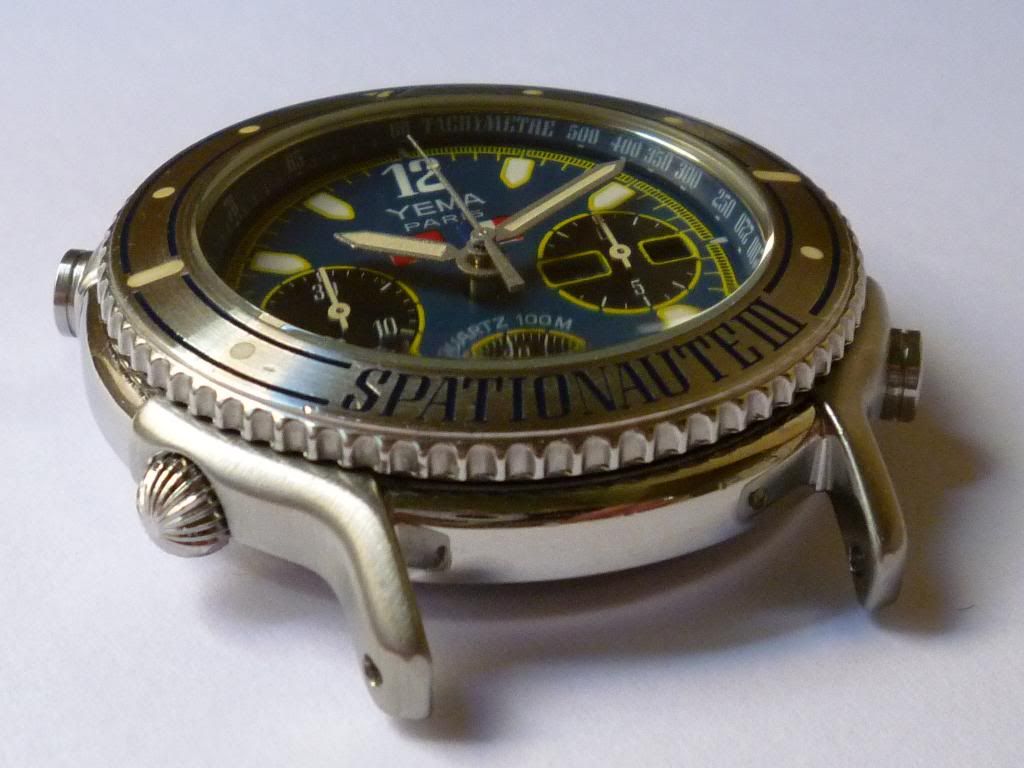
For the benefit of anybody who may also be looking for a replacement crystal for a (43mm diameter) Yema Spationaute III (or for that matter, a Yema N8 Flygraf) I suppose I ought to report on my results with that Cousins cheap substitute crystal. A little later than I'd originally planned, I finally finished the restoration that other ongoing project 'Mission Flags' dial Yema Spationaute III this morning.
Looking at the watch head on, you wouldn't know any different. Side on, the slightly domed profile is almost the perfect curvature too.
At relatively low angles of incidence everything still looks fine ....
But as you approach the horizontal, the distortion gets worse and worse ....
Which, even if you don't happen to spend a lot of time looking at your watch sideways on, is pretty awful compared to the OEM crystal:
The difference being that the Cousins crystal is flat bottomed, whereas the original Yema crystal is double domed (concave bottomed). I guess I can live with it for now, but the hunt for the perfect substitute (or ideally a couple of NOS original Yema crystals) continues. | |
| ||
 Site Owner Posts: 14428 |
Well, my experiment using a Cousin's 'cheap substitute' domed flat-bottom crystal on a Yema Spationaute III may not have entirely worked as well as I'd hoped, but I'm pleased to announce another application where they do work perfectly. Probably one of the most vulnerable domed crystals found in any Seiko 7Axx is p/n 320W46GN00 used in the 7A38-704x range (and also the JDM 7A38-7110 sibling). It's rare to buy a used watch that hasn't got at least a small scratch on the crystal - and sometimes they're almost opaque, like this:
Simon recently refurbished a 7A38-704A, he wrote: (I) fitted a new crystal (I'd bought two when I did the -704C). I thought Simon may have bought the last - but they're still available from Cousins UK - but their price is now up to £11.50 + VAT.
Not that I needed one myself, but when I placed my most recent order, I tacked on one of their p/n DF300CMH320 crystals - on spec.
This Q&D side-by-side shot doesn't really show much, but ....
Both are (obviously) 32.0mm diameter, 1.0mm high at the sidewall. The amount of doming is virtually identical. The only imperceptible difference is the overall height - Cousin's 'cheapie' substitute is exactly 3.00mm overall height; the genuine Seiko p/n 320W46GN00 is 3.05mm. The Cousins 'cheapie' crystal even has a tiny polished bevelled rim. Unlike the Yema Spationaute III's, the original Seiko crystal is flat bottomed, so the amount of distortion when the watch is viewed side-on will very likely be the same. The big difference is in the price. The Cousins substitute crystal costs £0.95 + VAT. | |
| ||
 Member Posts: 8 |
I need to obtain replacement pusher and crown gaskets for my 7a28-7070 but have been unable to find the part numbers on the Seiko Oceania site or Boley. Based on the above I'm assuming that there are two pusher gasket options for 7a28/7a38 - EG0060B01 & EC0060B0A Can you tell me whether the same logic that applies to the last two digits of the caseback gasket part numbers applies to pusher gaskets too i.e. EG0060B'01' generally apply to non-Sports 100 and EC0060B'0A' apply to the water resistant Sports 100 versions? I'm a newbie so apologies if this is a silly question or has been answered elsewhere- I did look before asking! Cheers . | |
| ||






You must login to post.